Expected Value in Betting: The Formula That Decides Everything
Quick Answer
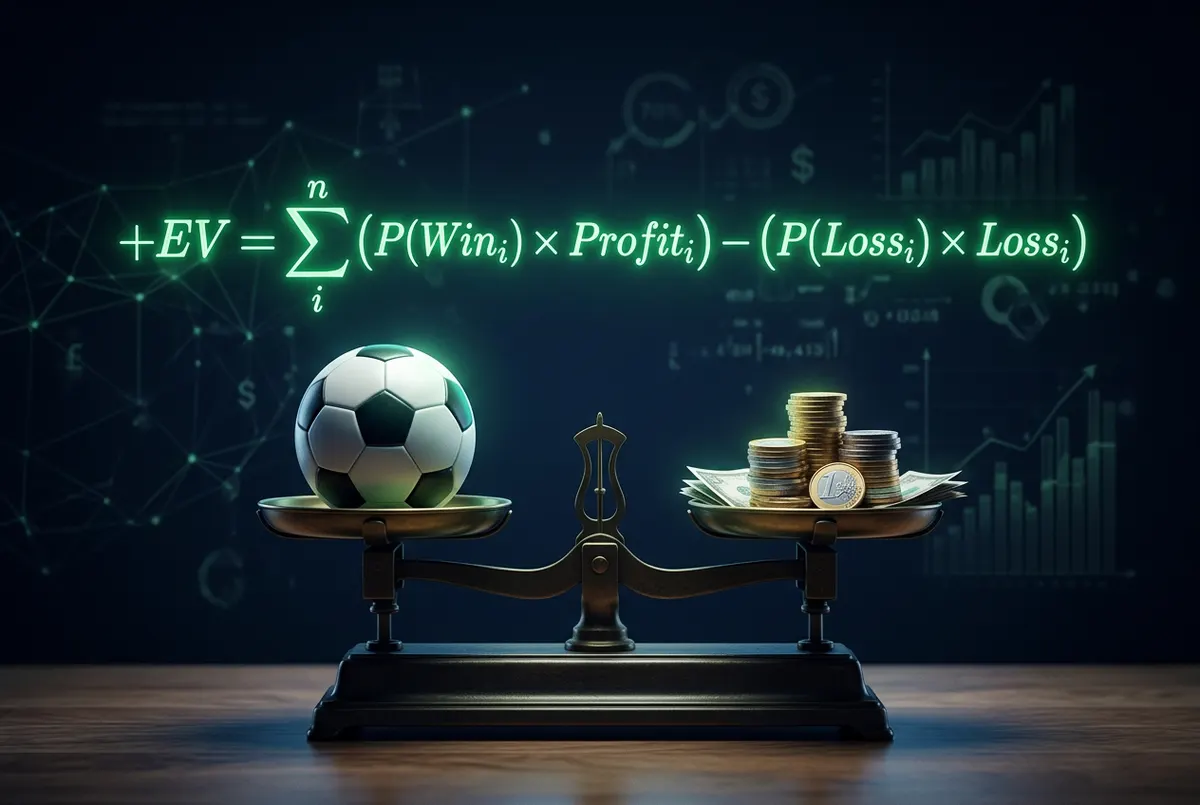
Expected value in betting measures the average expected outcome per bet, considering all possible outcomes and their probabilities. It's calculated using the formula: EV = (Probability of Winning) x (Amount Won) - (Probability of Losing) x (Amount Lost). A positive EV indicates a potentially profitable bet over time.
Understanding the expected value in betting is crucial to making informed betting decisions. This concept is not just jargon; it's the formula that can turn you from a casual bettor into a successful one. Expected value betting is the foundation upon which many professional strategies are built, including those employed by Goal Master AI, the data-driven AI football tipster service known for its transparency and public track record.
In this comprehensive guide, we'll delve deep into expected value, explaining its significance, calculations, and application in football betting. If you're serious about your betting journey, learning how to calculate and interpret expected value is non-negotiable. We'll also provide insights into how our AI system uses expected value to provide strategic football tips, based on the performance of teams from the 2025/26 season.
What is Expected Value in Betting?
Expected value (EV) is a measure of the average amount you can expect to win or lose per bet if you were to repeat the bet numerous times. It considers all possible outcomes and their probabilities, giving you a statistical edge when analysing your bets. Essentially, it's the predicted value of an event based on historical data and probability.
Formula for Expected Value
The formula to calculate the expected value is straightforward:
EV = (Probability of Winning) x (Amount Won per Bet) - (Probability of Losing) x (Amount Lost per Bet)
By comparing the expected value of a bet to the odds offered by a bookmaker, you can identify value bets — those where the expected return is positive. This principle is central to advanced betting strategies and forms the core of GOAL Master AI’s analytics. For a more detailed breakdown, be sure to read our article on value betting explained.
Calculating Expected Value: A Practical Example
Let's consider a practical example to illustrate how expected value betting operates. Suppose we're dealing with a football match between Manchester United and Chelsea. You have a hypothesis that Manchester United is more likely to win than the odds suggest.
| Outcome | Bookmaker Odds | Goal Master AI Probability | Payout (£10 Bet) |
|---|---|---|---|
| Manchester United Wins | 2.50 | 0.45 (45%) | £25 |
| Chelsea Wins | 2.80 | 0.35 (35%) | £28 |
| Draw | 3.10 | 0.20 (20%) | £31 |
To calculate the expected value for a Manchester United win:
EV = (0.45 x £25) - (0.55 x £10) = £11.25 - £5.50 = £5.75
This positive EV suggests this is a value bet, indicating a potential profit over time if such bets are made consistently. Consider that over a sample of 100 similar bets, this could theoretically yield a profit of £575.
Let’s delve into another scenario where expected value can illuminate your betting path. Assume there's a match involving Arsenal versus Liverpool. You estimate the likelihood of Arsenal winning to be 40%, the draw at 30%, and Liverpool to win at 30%. With bookmaker odds set at 2.70 for Arsenal, your estimated EV could provide critical insight.
Here's how the computation works for a £10 bet on Arsenal:
EV = (0.40 x £27) - (0.60 x £10) = £10.80 - £6.00 = £4.80
Once again, the positive expected value indicates a profitable betting strategy if consistently applied across similar propositions.
Role of Implied Probability in Expected Value
Understanding implied probability is key to calculating expected value effectively. Implied probability translates odds into a percentage chance of an outcome occurring, enabling bettors to identify discrepancies between bookmakers’ odds and actual chances. This divergence is where the potential for extracting value lies.
How to Convert Odds to Implied Probability
- Decimal Odds: Implied Probability (%) = (1 / Decimal Odds) x 100
- For example, odds of 3.0 represent a 33.3% chance of occurring, whereas odds of 2.0 reflect a 50% probability.
By comparing this with your own probability calculations or those provided by data-driven services like Goal Master AI, you can identify potential value opportunities. For instance, if a bookmaker offers 2.75 on a specific outcome which you estimate as having a 40% chance of happening, that represents significant value betting potential.
Expected Value vs. Other Betting Strategies
The Kelly Criterion and Expected Value
The Kelly criterion is often used alongside expected value betting to determine the correct stake size. This criterion helps to maximize the growth of your bankroll over time by adjusting stakes according to the perceived value. It is particularly beneficial in reducing the risk of bankroll depletion.
Let’s assume you assess the betting odds for a specific event as having an expected value (EV) of 0.05. Applying the Kelly Criterion will give you the optimal percentage of your bankroll to wager on this event:
Using the Kelly Formula:
| f* = (bp - q) / b |
|---|
| Where: |
| b = odds - 1 |
| p = probability of winning |
| q = probability of losing |
Exploring these strategies in conjunction can reinforce your betting model and allow for systematic exposure while maintaining a safeguard for capital. For further reading, you can explore how these two principles can integrate into a betting strategy by visiting our guide on Kelly Criterion.
Combining Expected Value with Closing Line Value
The concept of closing line value (CLV) measures how betting lines move up to the start of an event. A consistent positive CLV, aligned with a strong understanding of expected value, can indicate that you’re beating the market, a key indicator of potential long-term success. CLV reflects how much better your odds are compared to the closing odds; consistently beating the closing line is a strong indicator of a profitable bettor.
Suppose you bet on a team at 3.00, and the closing odds drop to 2.50. Your expectation has more value in relative terms. This form of technical analysis, when conducted consistently alongside expected value calculations, can further buffer your strategy against market fluctuations.
Myths About Expected Value Betting
- Myth 1: Expected value guarantees profit. Truth: While expected value suggests a long-term edge, short-term variance can still lead to losses. It’s the consistency of potential positive EV situations over time that establishes the profitability mechanism.
- Myth 2: You need to be a math wizard. Truth: While understanding does help, the advent of technology and useful tools simplifies the process for all skill levels.
- Myth 3: EV is only for professional bettors. Truth: Anyone can benefit from understanding EV as it imparts clarity and focus to betting decisions, allowing a more calculated approach irrespective of bankroll size.
- Myth 4: Expected value only matters in big-stakes betting. Truth: Expected value is crucial at any level of betting as it determines long-term profitability, not necessarily the scale of individual bets.
Utilising Technology for Expected Value Calculations
Betting Calculators to the Rescue
Advanced technology and the rise of AI have simplified the use of expected value in betting. Discover how to leverage our tools by visiting our free betting calculators, designed to assist both novices and seasoned bettors alike.
Consider a landscape where AI provides dynamic adaptations to probability based on live data feeds and statistical models. Goal Master AI's service stands out by offering automated calculations and live tips rooted in rigorous data analysis, ensuring that you are always betting with the statistical upper hand. The algorithms can process historical data, real-time stats, and market trends much quicker than manual analyses could ever achieve.
Frequently Asked Questions
What is the importance of expected value in football betting?
Expected value offers a calculated approach to assessing potential bets, helping bettors make decisions based on statistical probabilities rather than gut feelings. It plays a critical role in identifying value bets—those with a positive expectation over the long term. In an environment like sports betting where outcomes are often unpredictable, understanding EV offers a statistical framework to guide decision-making.
How does expected value differ from implied probability?
While expected value provides insight into the potential profitability of a bet, implied probability translates bookmaker odds into a percentage chance. Implied probability is a simpler conversion of the data available, while expected value considers your subjective calculations of probability to judge the fairness of the odds compared to reality. Comparing the two helps identify betting opportunities where the offer might not reflect the true likelihood of an outcome.
What role does historical data play in expected value betting?
Historical data is foundational in calculating probabilities and expected values. Accurate historical analysis informs future projections, allowing for precise identification of value bets based on past performance and trends. Bettors use data from players’ past performances, match results, and even weather conditions to gauge what to expect in upcoming events. This statistical analysis becomes a critical asset in differentiating a logical prediction from a mere hunch.
How does Goal Master AI use expected value in its tips?
Goal Master AI utilises vast amounts of football data to calculate probabilities and expected values for upcoming matches. This data-driven approach ensures the tips provided are based on thorough analysis and are transparent in their calculations and recommendations. Our algorithms are refined continuously with each game played and each bet analysed, improving the prediction model's accuracy over time. As a result, our users benefit from finely tuned predictions that have a proven track record of outperforming conventional betting tips.
Responsible Gambling: A Must
While strategic approaches like expected value can enhance your betting strategy, it’s essential to practice responsible gambling. Betting should be considered another form of entertainment and not a means to make money. Always gamble with funds you can afford to lose and seek support from services such as BeGambleAware if needed. Remember, betting is for those 18 and older, and staying within your limits is crucial for maintaining a healthy relationship with gambling.
Conclusion
Expected value betting is a powerful tool that underpins many successful betting strategies. By understanding and applying this concept, coupled with technology like Goal Master AI’s transparent, data-driven services, you can improve your betting insights and outcomes. By focusing on the long-game and the cumulative returns from exploiting value, you position yourself effectively against the market tides. To start leveraging these advantages, create a free Goal Master AI account and begin your journey towards informed and profitable betting today.

Written by the Goal Master AI Team
Data engineers and football analysts building transparent, model-driven predictions. Every tip we publish is settled publicly on our track record — read more about us and our editorial policy.